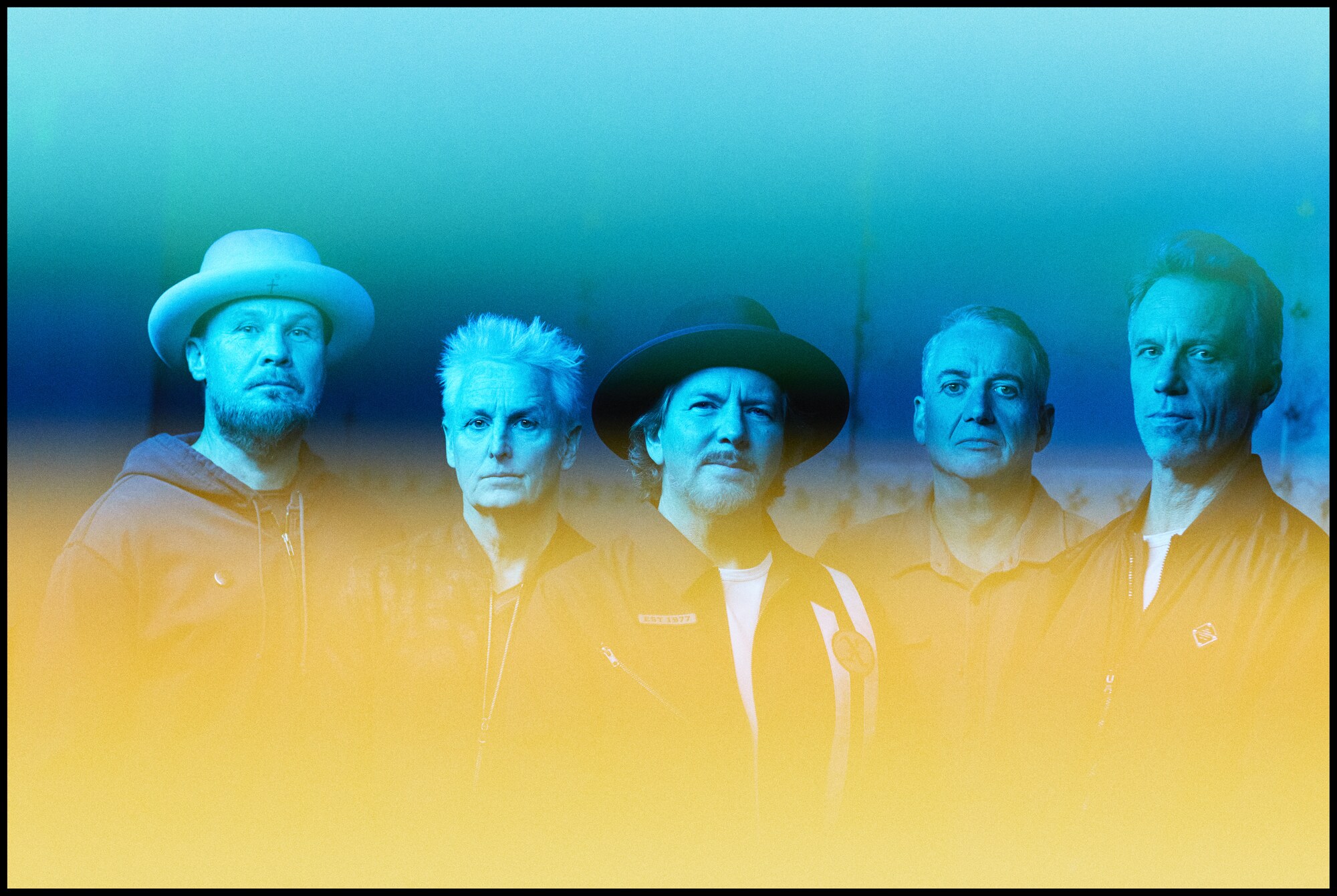
Photo: official artist website
Rock · 6 min read
Pearl Jam
Pearl Jam are an American rock band whose music combines powerful guitars, emotional storytelling and a strong sense of conviction. Formed in Seattle in 1990, they became one of the defining bands of the alternative-rock movement that transformed popular music in the early 1990s. Their connection to that period remains important, but their catalogue stretches far beyond it. Across decades of recording and performing, Pearl Jam have explored anger, grief, love, injustice and survival, building songs that can feel intensely personal even when thousands of people are singing them together.
At the centre of their sound is Eddie Vedder’s voice: deep, expressive and capable of moving from a quiet murmur to a forceful roar. He often sounds as though he is working through the emotion of a song while singing it. Around him, guitarists Stone Gossard and Mike McCready and bassist Jeff Ament have built a musical partnership with considerable range. Their arrangements can be muscular and direct, but they also leave space for melody, atmosphere and smaller details. The result is a band whose quieter songs carry as much identity as their loudest performances.
Their debut album, “Ten,” released in 1991, introduced that combination with remarkable confidence. “Alive,” “Even Flow” and “Jeremy” brought them widespread attention, while “Black” became another essential part of the record’s lasting appeal. The album’s broad guitar sound and emotionally charged vocals made it accessible to a large audience without softening the difficult experiences within the writing. It captured the feeling of young people trying to understand themselves in circumstances that could be confusing, isolating or painful.
“Black” shows how effectively Pearl Jam can build a song around emotional restraint. Its opening leaves room for the voice and chords before the performance gradually becomes more intense. The feeling grows through repetition, phrasing and the relationship between the instruments. “Alive” reaches towards a different kind of release, with a guitar figure and chorus that invite a collective response. These songs demonstrate an enduring strength of the band: they can take something private and give it a musical form that other people can inhabit.
Their second album, “Vs.,” released in 1993, brought a more confrontational energy. Songs such as “Go,” “Animal” and “Rearviewmirror” have a restless physical force, while “Daughter” and “Elderly Woman Behind the Counter in a Small Town” reveal the sensitivity within the writing. The contrast matters. Pearl Jam’s intensity has always included empathy, with songs that look beyond the singer to consider other people’s experiences. Their characters can feel overlooked, misunderstood or trapped, and the music gives those feelings weight.
“Vitalogy,” released in 1994, pushed the band towards a more unsettled and experimental sound. Fast, abrasive passages sit beside reflective songs, making the album feel emotionally unpredictable. “Corduroy,” “Nothingman” and “Better Man” became central to their catalogue, each showing a different relationship between vulnerability and strength. “Better Man,” in particular, places a difficult relationship inside a melody that is immediately memorable. The ease with which an audience can sing along does not remove the sadness at the song’s centre.
As their career developed, Pearl Jam became increasingly willing to challenge expectations. “No Code” in 1996 explored a broader and less immediately familiar musical space, while “Yield” in 1998 brought another set of distinctive songs, including “Given to Fly,” “Wishlist” and “Do the Evolution.” These records show how the band could change the mood and structure of their music while retaining their identity. A song might move towards reflection, a loose groove or a sharp burst of aggression, with the musicians responding to what the writing needed.
Their relationship with their audience became one of the most significant parts of their longevity. The Ten Club fan community and extensive series of officially released concert recordings gave listeners ways to follow the band beyond studio albums. Live performance became an ongoing part of their musical story. Songs could take on different emphasis in concert, and the audience’s participation became part of their emotional effect. For dedicated listeners, following Pearl Jam meant developing a relationship with a body of work that continued to change on stage.
The later catalogue added further dimensions. “Binaural” in 2000, “Riot Act” in 2002 and the self-titled “Pearl Jam” in 2006 carried the band into a new decade, with songs that continued to combine personal reflection and wider concerns. “Backspacer,” released in 2009, included “Just Breathe,” a gentler example of their songwriting. Its acoustic setting makes room for affection, gratitude and an awareness of how brief life can be. That tenderness belongs naturally within Pearl Jam’s music, alongside its more urgent and confrontational moments.
Their willingness to experiment remained evident on “Gigaton,” released in 2020. “Dance of the Clairvoyants” introduced a more angular, rhythm-focused approach, showing that the band could still surprise listeners familiar with their usual guitar sound. Across the album, forceful rock songs sit beside quieter passages and less conventional textures. The record carries anxiety about the wider world, but it also searches for ways to keep moving through that uncertainty.
Their twelfth studio album, “Dark Matter,” arrived on 19 April 2024, produced by Andrew Watt. Recorded with Eddie Vedder, Stone Gossard, Mike McCready, Jeff Ament and drummer Matt Cameron, it grew from sessions that emphasised the band playing together. That approach placed their musical interaction at the centre of the record. Decades into their career, the energy of musicians responding to one another remained a powerful part of their sound. Cameron, who had joined in 1998, subsequently announced his departure in July 2025 after 27 years with the band.
Pearl Jam’s identity also extends to their public commitments. Their charitable work through the Vitalogy Foundation has supported causes including homelessness, environmental issues, reproductive rights and medical research. Their induction into the Rock & Roll Hall of Fame in 2017 recognised a career shaped by both musical influence and a strong connection with listeners. Those commitments help explain why the band’s following often feels like a community built around shared concerns as well as shared songs.
What gives Pearl Jam their lasting emotional force is the room their music makes for different kinds of strength. Sometimes it appears as anger or resistance; elsewhere, it comes through admitting pain, expressing affection or refusing to give up. Their best performances allow those feelings to remain complicated. A song can be heavy and tender, wounded and hopeful, without resolving neatly into one mood.
From the searching intensity of Ten to the collective energy of Dark Matter, Pearl Jam have built a catalogue that rewards time and attention. The familiar songs offer an immediate way in, while the deeper album tracks reveal a band with a much wider emotional and musical range. Their music continues to connect because it gives difficult feelings a voice—and, in the shared experience of a concert or a favourite recording, a sense of company.
Artist background: Official Pearl Jam website · Pearl Jam releases on Apple Music
Watch Pearl Jam
Yellow Ledbetter — Live at The Showbox
Watch on YouTube ↗YouTube loads when you press play. Some videos may need to open on YouTube.
Start with these
- Black
- Alive
- Even Flow
Listening opens in your chosen service. Availability and subscription requirements may vary.
What do you think?
Join the conversation about Pearl Jam.
Loading comments…